Fat loss & accountability
How to Stay Consistent With Training When You're Genuinely Busy
By Maciej Nowicki · Updated 2 September 2026
Consistency doesn't come from motivation — it comes from four systems: a programme built around your real diary, a minimum-viable session for chaos weeks, planning your life into the calories instead of around them, and someone who notices when you drift. Busy people don't need more discipline; they need less friction.
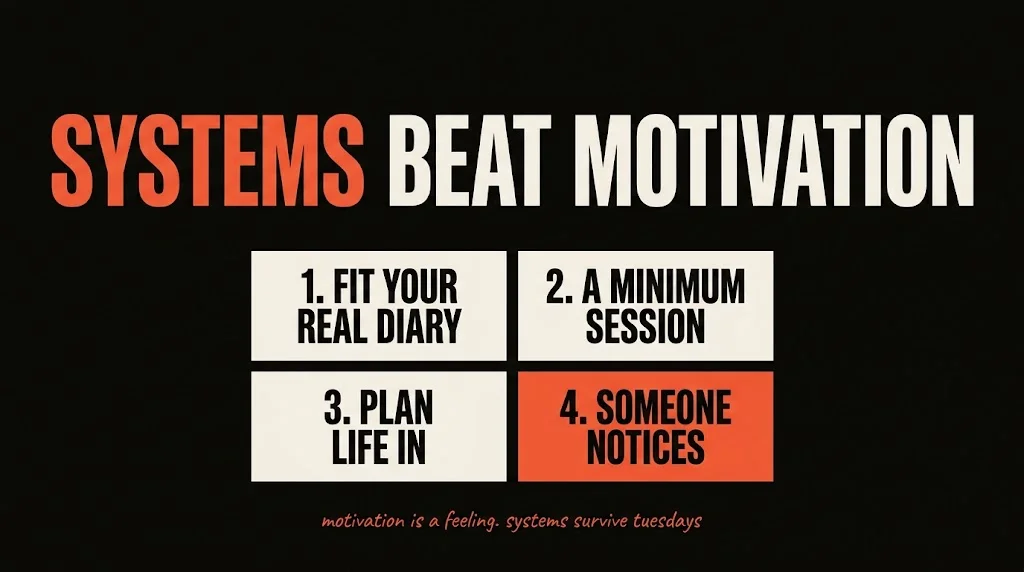
Every article on this topic is a listicle written by someone whose job is going to the gym. Mine isn't. I'm Mac, and my entire client base is people with genuinely full lives — salon owners, shift workers, dads doing school runs, blokes travelling for work every week. None of them got consistent by finding motivation. They got consistent because we built systems that don't need any. Here are the four, with the receipts.
First, kill the motivation myth
Motivation is a feeling, and feelings don't survive a Tuesday. If your plan requires you to feel like training, you've built a plan that works on holiday and dies at work. The clients on my results page aren't more motivated than you — Craig ran a barber shop through a refurb with kids at home and work travel all over the country, and went from failing a 2k run to finishing the Leeds Marathon inside a year. What he had wasn't willpower. It was the four things below, plus someone checking weekly that they were still happening. In his words: “Motivation comes and goes — what Mac has helped me build is far more valuable. Discipline. Consistency. Dedication.”
System 1 — The programme fits your diary, not your fantasy diary
The five-day split you found online assumes a life you don't have, and the first week it collides with reality, the whole plan feels broken. I build the other way round: Craig's programme is gym twice a week plus runs, because that's what his shop allows. Jack's fits around a salon and a young daughter. Two sessions you always do beats five you mostly don't — and consistency at two builds the appetite for three later. Start from your worst realistic week, not your best imaginary one.
System 2 — Have a minimum-viable session
Chaos weeks come. The difference between consistent people and restarters is what happens in them: restarters skip, because the plan was all-or-nothing; consistent people have a floor — a 25-minute version of the session, a walk, something that keeps the identity alive. You'll see rules like 3-3-3 or 3-2-1 going round — the numbers are arbitrary, but the instinct behind them is right: a small pre-decided “minimum” removes the negotiation. The session you do at 60% effort counts for more than the perfect one you skipped, because zero is the only number that compounds against you.
System 3 — Plan your life into the plan, not around it
Busy lives contain weddings, client dinners and weekends. A plan that pretends otherwise gets cancelled by the first one. Every Friday I message clients about the weekend ahead — the meal out, the pints — and we put them in the week's numbers before they happen. My clients still go out; the pints are in the plan. It's the 80/20 core of the Mac Method, and it's why their diets survive real calendars. If your weekends keep erasing your weekdays, that maths is broken — I've laid it out in the stalled-weight diagnostic.
System 4 — Someone has to notice when you drift
This is the one no app provides and the one that separates my clients' results from their previous attempts. Drift is invisible from inside: sessions quietly shorten, weigh-ins stop, and no streak counter ever messaged anyone to ask why Thursday disappeared. A weekly check-in with a human who reads your actual data turns drift into a Tuesday correction instead of a January restart. Jack — salon, travel, new baby — put it simply: “It's been amazing having a coach 24-7… it never makes me feel bad, it just encourages me.” And from the comments on my page: “he's there with you every step of the way.” That presence is the system.
The busy person's consistency checklist
- Sessions per week you can hit on your WORST week — build there, expand later
- A written minimum-viable session for chaos days (25 minutes, three lifts, done)
- Training booked in the diary like client meetings — a time, not an intention
- This weekend's social events already inside this week's calories
- One person who sees your week's data and will ask when it goes quiet
FAQs: staying consistent when you're busy
What is the 3-3-3 rule for fitness?
How many days a week do I need to train to see results?
I'm too tired to train after work — what do I do?
Why do I always quit after two or three weeks?
Do I need a coach just to stay consistent?
Do something with it
Reading is the easy rep. The next one is seeing how this works applied to you.
See how coached accountability works