Fat loss & accountability
What Is TDEE? And How to Actually Use It to Lose Fat
By Maciej Nowicki · Updated 2 September 2026
TDEE (Total Daily Energy Expenditure) is the total calories your body burns in a day — your resting metabolism plus all movement, exercise and digestion. To lose fat, eat 300–500 calories below it, track your weekly weight trend, and adjust from the trend, not the calculator. The calculator gives an estimate; your scale gives the truth.
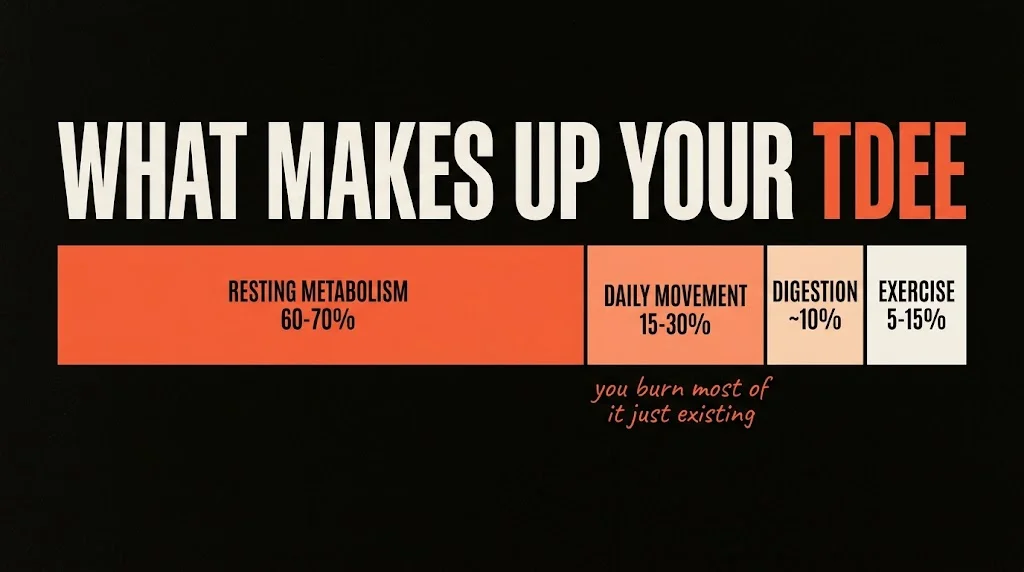
Every plan I write starts from one number, and it's this one. TDEE — Total Daily Energy Expenditure — is simply how many calories your body burns in a normal day, everything included. Most pages about it are either a calculator with three lines of text or a physiology lecture. I'm Mac, I've coached off this number for nine years, and what follows is the version I actually talk clients through — including the part the calculator sites always skip: what to do with the number after you've got it.
What your TDEE is made of
| Component | What it is | Rough share |
|---|---|---|
| BMR (resting metabolism) | What you'd burn in a coma — keeping organs running | 60–70% |
| NEAT (daily movement) | Walking, standing, fidgeting, carrying shopping | 15–30% |
| TEF (digestion) | Calories burned processing food — highest for protein | ~10% |
| Exercise | Your actual training sessions | 5–15% for most people |
Two things jump out of that table when clients see it. First: your resting metabolism does most of the work — you burn most of your calories existing, not exercising. Second: everyday movement (NEAT) usually outburns the gym. Yes, walking absolutely counts — for a lot of my clients, the daily walk moves their TDEE more than their training sessions do.
TDEE vs BMR — which one do you eat below?
TDEE. Always TDEE. Your BMR is just the resting-metabolism slice — eating “below BMR” or “above BMR” isn't the system. The deficit that drives fat loss is measured against your total burn. Most of the confusion online comes from people reading their BMR off a calculator and thinking it's their target. It isn't — it's about 30–40% short.
How to actually use it: the three-step loop
- 1. Get the estimate. My free TDEE calculator takes 60 seconds and gives you your number plus macro targets.
- 2. Set the deficit. Eat 300–500 calories below it (see how far below TDEE you should go for sizing it properly), with protein around 2g per kg so what you lose is fat, not muscle.
- 3. Adjust from the trend. Weigh daily, average weekly, and after two weeks let the trend overrule the calculator: losing 0.5–1% of bodyweight a week? The number's right. Flat? Your real TDEE is lower than estimated — drop 100–150 calories and re-test.
Step three is the whole game, and it's the step nobody does alone. A calculator is a well-educated guess — usually within about 10%, which on 2,500 calories is a 250-calorie error, enough to erase a small deficit entirely. The calculator starts the process; your weekly trend line finishes it. When my clients check in on a Sunday, that trend line is the first thing I look at.
Your TDEE is a moving target (and that's good news)
The number isn't fixed. Diet for months and it drifts down — you're lighter, and your body quietly economises. Train consistently, build muscle, move more, and it climbs. My client Craig is the extreme case: his fat-loss phase bottomed out at 1,800 calories, and after a proper reverse diet he was building muscle on 3,650 — over double — while staying lean. Same body, transformed engine. If you treat the number you calculated in January as gospel in June, you'll be fighting last season's war. Craig's full journey is here.
Where people go wrong with TDEE
- Setting activity level to 'very active' because they train 3x a week — most people with desk jobs are 'lightly active', and the flattery costs them 300 calories of accuracy.
- Eating back exercise calories the watch reported. Your TDEE already includes normal training; eating them back double-counts.
- Recalculating obsessively instead of tracking the trend. The scale over 14 days knows your TDEE better than any formula.
- Treating a flat week as a broken metabolism instead of an accounting problem — it's almost always the tracking, not the thyroid.
FAQs: TDEE
Will I lose weight if I eat under my TDEE?
What's the most accurate TDEE calculator?
Does walking count towards TDEE?
Does TDEE drop when you diet?
Should I eat at TDEE on rest days?
Do something with it
Reading is the easy rep. The next one is seeing how this works applied to you.
How fat-loss coaching uses your numbers