Fat loss & accountability
Why Am I Not Losing Weight Even Though I Exercise?
By Maciej Nowicki · Updated 26 August 2026
You're almost certainly eating at or above maintenance without realising it — exercise burns less than it feels like, and untracked weekends quietly cancel weekday deficits. Run this 4-step diagnostic in order: verify your deficit with your TDEE, audit the weekend, drop all-or-nothing rules, and add accountability. Two consistent weeks settles it.
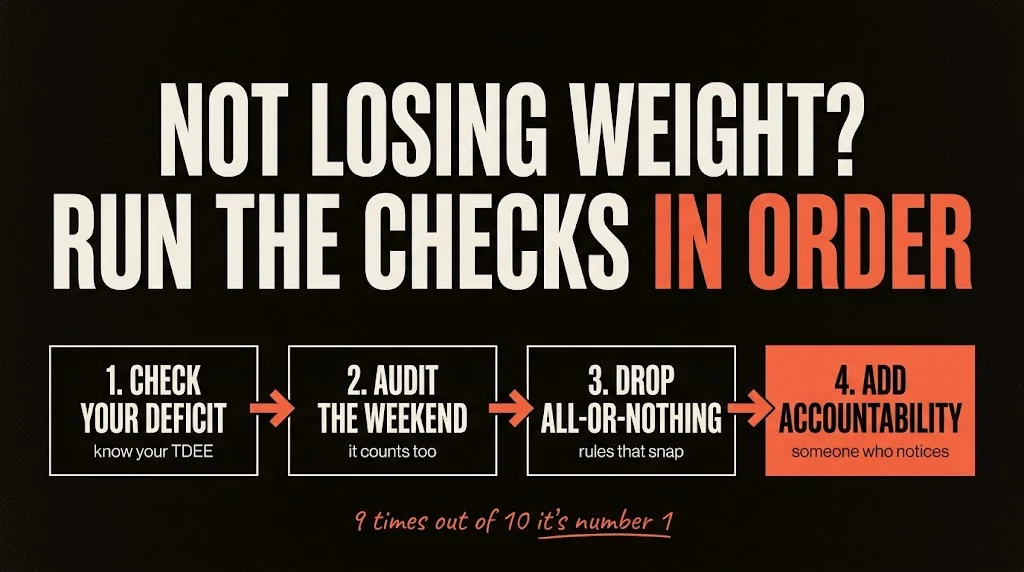
You're training regularly and the scale won't move. Before you conclude your metabolism is broken — it almost certainly isn't — I want you to run the same diagnostic I run with every new client who arrives saying exactly this. Four checks, in order of likelihood, each with a self-test you can do this week. Most health sites will give you fourteen reasons and no starting point; you only need the four that actually happen, in the order they actually happen.
Step 1 — You're not actually in a deficit (yes, even you)
This is the answer roughly nine times out of ten, and it's nobody's fault: humans are terrible at estimating intake. Classic research found people under-report what they eat by around 47% — the Lichtman study in the New England Journal of Medicine is thirty years old and still embarrassingly relevant. Meanwhile a hard training session burns 300–500 calories — one large latte and a flapjack on the way home puts them all back.
The self-test: get your TDEE — the calories you burn in a normal day — from my free calculator, set a target 300–500 below it, and track everything you eat for 14 straight days. Not a typical fortnight — an accurately recorded one. Most people find the deficit they were “definitely in” existed about four days a week.
Step 2 — The weekend is cancelling the week
The most common shape of Step 1's problem deserves its own step, because it hides so well. Watch the maths:
| Calories vs maintenance | |
|---|---|
| Monday–Friday: 300 under each day | −1,500 banked |
| Saturday: takeaway, a few pints, dessert | +1,300 |
| Sunday: hungover brunch, picking, big dinner | +600 |
| Net for the week | +400 — a surplus |
Five disciplined days, erased in 48 hours that felt like “one blowout”. The fix isn't a monk's weekend — it's planning the weekend into the week's numbers, which is the whole point of the 80/20 approach in the Mac Method. My clients still go out. The pints are in the plan.
The self-test: track Saturday and Sunday with the same honesty as Tuesday. If weekend calories are a mystery, you've found your answer.
Step 3 — All-or-nothing rules that snap
Banned foods, perfect streaks, “clean eating” — they all work brilliantly until the first birthday cake. Then one slip becomes a written-off week, because the rule was perfect-or-pointless, and you “start again Monday” from further back than you stopped. Fat loss is never a fortnight; flexible structure beats strict rules over any timeline longer than that.
The self-test: count your “day ones” this year. More than three restarts is a rules problem, not a willpower problem — the rules are set to a difficulty no human passes.
Step 4 — Nobody notices when you drift
Slow drift is invisible from inside it: portions creep, sessions quietly shorten, the weigh-ins stop because you'd rather not know. This is the step no app fixes — a streak counter has never once messaged anyone asking why Thursday's session disappeared. Tom trained for years before we met — gym-going, effort in, no direction, no one watching the data. With a weekly review loop on it, the same effort took him from 160kg to under 90. He tells it better than I do.
The self-test: can anyone other than you say what your training and weight trend did last week? If not, you have no drift alarm — a training partner, a public log, or a coach all work.
When it genuinely might be medical
The honest caveat: a minority of stalled weight loss has a medical driver — thyroid conditions, PCOS, some medications, and poor sleep all make fat loss meaningfully harder. If you run the 14-day test below with genuine accuracy and the trend still won't move, that's a GP conversation, not a harder diet. A coach who says otherwise is selling outside his lane — and this is general information, not medical advice.
The 14-day test that settles it
- Get your TDEE and set a 300–500 calorie deficit — numbers, not vibes.
- Track everything for 14 straight days. Weekends included. No judging until day 14.
- Weigh daily, first thing; act only on the weekly average.
- Keep protein high — around 2g per kg of bodyweight — so what you lose is fat, not muscle.
- Trend moved? You've found your answer — keep going. Trend flat with honest data? Now it's worth a GP check or a coach's eyes on your numbers.
FAQs: exercising but not losing weight
Why am I gaining weight while working out?
How long does it take to see weight loss from exercise?
Can you lose weight with exercise alone, without dieting?
Should I eat back the calories my watch says I burned?
Is it my slow metabolism?
Do something with it
Reading is the easy rep. The next one is seeing how this works applied to you.
How fat-loss coaching fixes this