Fat loss & accountability
How Far Below Your TDEE Should You Eat to Lose Weight?
By Maciej Nowicki · Updated 2 September 2026
For most people, eat 300–500 calories below your TDEE — around 10–20% — which loses roughly 0.5–1lb of fat a week. Go bigger (up to 25%) only with a lot to lose; go smaller for the last stone. The right deficit is the largest one you can sustain without your adherence snapping.
Once you know your TDEE, the next question is the one that decides whether the diet works: how far under it should you actually eat? Search this and you get a nine-year-old Reddit thread and a pharmacy calculator. Here's how I actually set deficits for clients — because the honest answer isn't one number, it's a decision, and getting it wrong in either direction costs you.
The short answer, then the real one
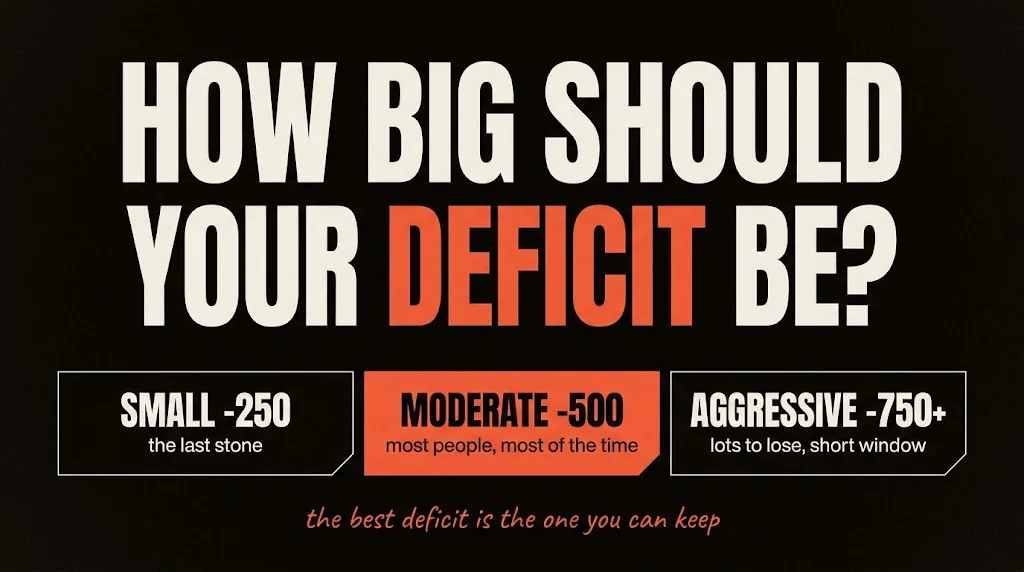
Default: 300–500 calories below TDEE, roughly 10–20% under, losing about 0.5–1lb of fat a week. That's the zone where the food still feels like a life, training still has fuel, and the loss shows up on the trend line. But the right deficit depends on where you're starting from:
| Deficit | Rate of loss | Best for | The catch |
|---|---|---|---|
| 250–300 kcal (~10%) | ~0.5lb / week | The last stone; anyone who's rebounded before | Slow — needs patience and tight tracking |
| 500 kcal (~15–20%) | ~1lb / week | Most people, most of the time | Weekends can quietly erase it — plan them in |
| 750–1,000 kcal (20–25%) | 1.5–2lb / week | A lot to lose (16 stone+), or a hard deadline | Hunger, flat sessions, and an adherence cliff |
Notice the pattern: the more you have to lose, the bigger the deficit your body will happily support. Tommy averaged around a kilo a week for ten months from a 133kg start — appropriate for him, reckless for someone chasing their last 10lb. Craig, much lighter, cut on a floor of 1,800 calories and we refused to go lower, because the data said his adherence would break before his body fat did. The deficit that works is the biggest one you can run for months, not days.
Percentage beats a flat number
“500 below” is a fine rule of thumb — unless your TDEE is 1,700, where it's a brutal 30% cut, or 3,500, where it's barely a rounding error. Think in percentages: 10–20% below TDEE for normal cutting, up to 25% short-term when there's a lot to lose. My free calculator does this maths for you.
The 1,200-calorie myth (and the BMR one)
Two rules float around the forums as laws of physics. “Never eat under 1,200” — 1,200 is just a historical default aimed at smaller women, not a biological floor; for a small, light, sedentary person a coached plan slightly under it can be fine, while for a 15-stone man it would be senseless. And “never eat below your BMR” — your body doesn't treat BMR as a tripwire; the reason very low calories fail is simpler: you can't stick to them, you lose muscle, and you learn nothing you can keep doing. The floor that matters is the one your adherence sets.
Three rules that protect the deficit
- Don't eat back exercise calories. Your TDEE already includes training, and watches overestimate burn. Set the deficit, ignore the “calories earned” number.
- Protein goes up as calories go down. Around 2g per kg of bodyweight — it keeps muscle on you and hunger off you. (My free protein guide makes hitting it easy.)
- Take maintenance breaks on long diets. Dieting more than 10–12 weeks? A deliberate week at maintenance every 6–8 weeks resets hunger, training and sanity — a planned pause, not a failure.
When the scale stops moving
The wrong response to a stall is the reflex one: slash another 500. First rule out the accounting — untracked weekends cancel more deficits than metabolism ever has (my 4-step stalled-weight diagnostic walks through it). If the tracking is genuinely tight, adjust in small moves: 100–150 calories down, or 2,000 steps up, then give it two weeks. This is precisely what a coached plan automates — the weekly check-in exists so these calls get made from your data, not your frustration.
FAQs: calorie deficits and TDEE
Is a 1,000-calorie deficit too much?
Do I need to eat less than my TDEE every single day?
How fast should I be losing weight per week?
Will a bigger deficit get me there faster?
Should I cut calories further every time I plateau?
Do something with it
Reading is the easy rep. The next one is seeing how this works applied to you.
Get your deficit set and managed for you