Choosing online coaching
What Six Months of Online Coaching Actually Looks Like (Month by Month)
By Maciej Nowicki · Updated 2 September 2026
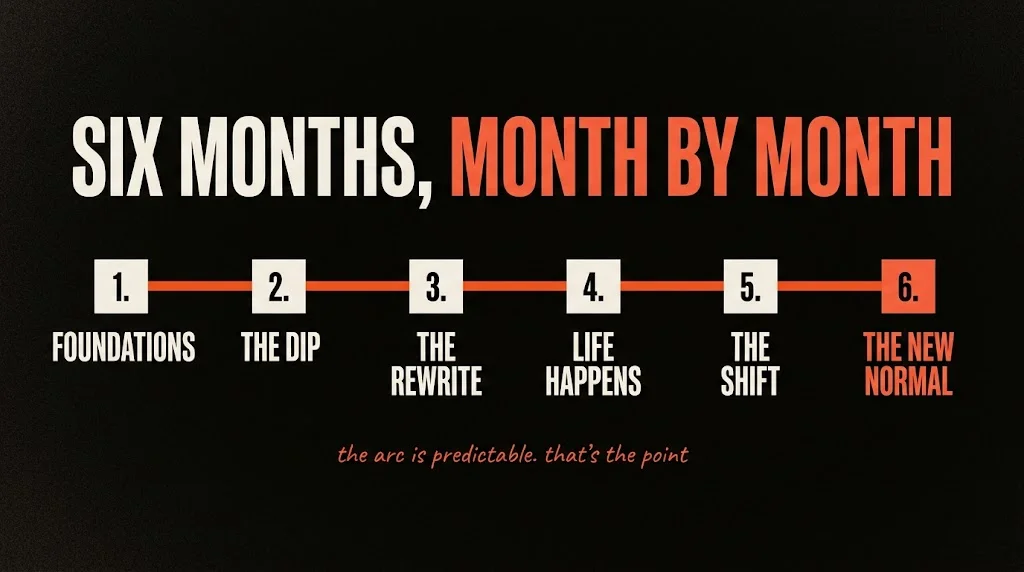
Six months of online coaching follows a predictable arc: foundations and fast early losses in month one, a plateau and first plan rewrite around month three, a life stress-test somewhere in the middle, and a 'new normal' by month six where the habits run themselves. This article walks the whole arc month by month, using four real clients.
I'm Mac. I've run six-month coaching for years, and I've watched the same arc play out dozens of times — often enough that I can usually tell a client what week their first wobble will land in before they've had it. Most articles about “what to expect from online coaching” are coaches describing their onboarding form. This is the other thing: the actual six months, month by month, told through four real clients — Tom, Tommy, Craig and Jack — whose full stories and videos are on the results page, so you can check I'm not inventing anyone.
Month 1 — Foundations, and the check-in that surprises people
The first week isn't a beasting. We work out your TDEE, set calorie and protein targets around food you already eat, and build training into the diary you actually have — not the diary you wish you had. Jack runs a salon and had a newborn; his programme started where his life was, which is why it survived. The scale usually drops fast in month one, and I tell every client the same thing: a chunk of that is water and glycogen, not fat. Enjoy it, don't extrapolate it.
The bit nobody expects is the first honest check-in. Tommy almost didn't join because he assumed online coaching meant a copy-and-paste PDF; what he got on Sunday one was a real conversation about a real week, with no judgement attached. “I've been proven wrong,” is how he puts it now. “The one-to-one support is what's got me to where I am today.”
Month 2 — The novelty wears off (this is the point)
Somewhere in weeks five to eight, training stops being new and starts being Tuesday. This is where every previous attempt quietly died, and it's where coaching starts earning its money. Your data tells me when you're drifting — sessions shortening, weigh-ins going quiet — and I'm on it before a wobble becomes a written-off month. Jack's words: “It never makes me feel bad, it just encourages me.” The plan also starts bending here: the minimum-viable session exists for hell weeks, and the weekend gets planned into the calories rather than confessed afterwards.
Month 3 — The plateau, and the first proper rewrite
Around month three the easy losses are gone and the scale has a flat fortnight. Untrained people panic here; coached people get a plan rewrite built on eight weeks of their own data. Sometimes calories come down a notch, sometimes activity goes up, and sometimes — counter-intuitively — the right move is a week at maintenance before pushing again. Craig's cut bottomed out at 1,800 calories; we didn't just keep slashing, because the numbers said his adherence would snap before his body fat did. If your weight has stalled and nobody's reviewing your data, my stalled-weight diagnostic is the DIY version of what happens in this month.
Month 4 — Life happens: the stress-test month
Nobody gets six clean months. Somewhere in the middle you get the work trip, the holiday, the family crisis — the month that killed every plan you've tried before. Tommy lost his grandad weeks before his photo shoot, in the middle of the hardest year of his life, and his structure was the thing that held: “this shoot was the only thing that kept me on the straight and narrow.” Craig went through a shop refurb, kids and work travel all over the country. The plan's job in month four isn't progress — it's not losing the first three months. Maintaining through chaos is the win, and a coach is the difference between a bad month and a quiet quit.
Month 5 — The identity shift
This is my favourite month to coach. Training stops being a thing you're trying and becomes a thing you are. Other people notice before you do — Jack's wife started commenting, and his reason for the whole thing surfaced: “I hope my daughter sees her dad as a strong figure, mobile for all of her life.” For some clients month five is where food starts going up, not down: Craig finished his cut, reverse-dieted, and eventually built at 3,650 calories — double his dieting intake, while staying lean. That's what a full system looks like, and it's the part no 12-week plan ever reaches.
Month 6 — The new normal
By month six you know your numbers, you know your training, and — because I explain the why behind every adjustment — you know the system well enough to run it. Tom, who lost over ten stone with me, said the thing I'd put on the wall if I had an office: “there is no finish point. It's about constant progress and realising that fitness is forever — not a 12-week challenge.” That's also exactly why my coaching is six months rolling and not a twelve-week transformation: twelve weeks changes your body, six months changes the person running it.
| Month | What you feel | What I'm actually doing |
|---|---|---|
| 1 | Fast scale drop, structure feels new | Setting TDEE, food and training around your real life |
| 2 | Novelty fades, first wobble | Catching drift in your data before it becomes a quit |
| 3 | The plateau | First full plan rewrite, built on 8 weeks of your numbers |
| 4 | Life explodes | Bending the plan so a bad month doesn't erase three good ones |
| 5 | People start noticing | Fine-tuning; for some, reversing calories back up |
| 6 | It's just who you are now | Teaching you the system so year two doesn't need me |
Who six months does NOT work for
- People who won't check in. The weekly review is the engine — ghost it and you're paying for a plan, not coaching.
- People who want a finish line. If you need the diet to end on a date, a 12-week challenge will feel better and rebound harder.
- People who just need a plan. If you've never followed structure at all, start with my free tools and come back when consistency breaks.
What clients say, unfiltered
Straight from the comments on my Instagram — real accounts, on public posts you can find yourself:
- “Mac is not like any other online coach… he's there with you every step of the way. I've been with him for 6 months but results are unbelievable already, physically and mentally.” — Karoliina
- “I often describe Mac as a life coach.” — a client of two years
- “He is amazing. I'm getting my health & weight back under control.” — Christine, who found me through Jack
FAQs: what to expect from online coaching
How quickly should I see results with an online coach?
What happens in the first week of online coaching?
What if I hit a plateau during the six months?
Is 12 weeks of coaching enough?
What does six months of coaching cost?
Do something with it
Reading is the easy rep. The next one is seeing how this works applied to you.
See how the 6-month coaching works