Fat loss & accountability
Cortisol Belly: Is It Real? What the Research Actually Shows
By Maciej Nowicki · Updated 23 November 2026
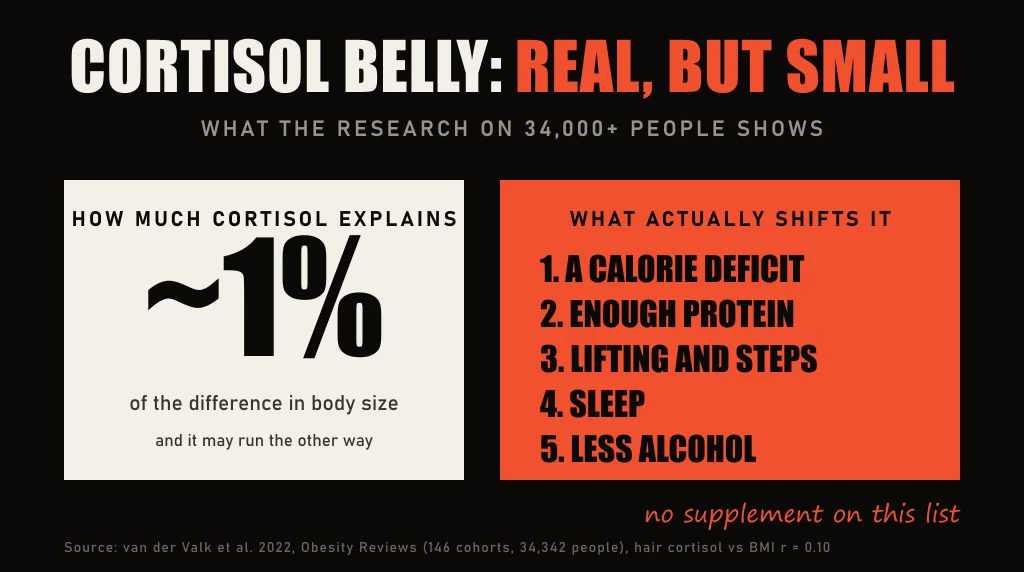
Cortisol belly is a social media term, not a diagnosis. Long-term cortisol is linked to belly fat, but the link is small: across studies of over 34,000 people it explained about 1% of the difference in body size. For most people, stress adds belly fat through eating, sleep and alcohol, and a calorie deficit is what takes it off.
I'm Mac. Scroll for long enough and someone will tell you your belly fat isn't your fault. It's your cortisol, and the fix is their supplement, their “cortisol cocktail” or their hormone reset. I understand why it lands. It's a kinder story than calories. But if you're trying to lose the belly, the story you believe decides what you do next, so it's worth knowing what the research actually says.
What is cortisol belly?
It's a social media term for fat around your middle that people blame on stress and the stress hormone, cortisol. It isn't a medical diagnosis. Cortisol itself is a normal, useful hormone. It helps you wake up, manage blood sugar and deal with pressure, and it rises and falls through the day.
Is cortisol belly real?
Partly. There is a link between long-term cortisol and belly fat. It's just much smaller than the videos suggest, and nobody knows for sure which way round it goes.
- The link is real. In a study of 59 women, those carrying more fat around their middle released more cortisol under stress in the lab. Deep belly fat can also make its own cortisol, according to lab research on fat tissue.
- But it's small. The biggest review so far, of 146 groups and 34,342 people, measured long-term cortisol in hair. The link with BMI was a correlation of 0.10. In plain English, cortisol explained about 1% of the difference in people's size. Even the strongest measure in the review explained only about 3% of the difference in waist size.
- And it might run backwards. The authors of a study of 2,527 older adults in England point out that carrying extra weight could be what raises cortisol, rather than the other way round. A systematic review of this research called it “inconclusive”.
How stress really shows up on your waist
Stress matters, but mostly through what it makes you do. When I look at a stressed client's week, the belly usually traces back to one of these:
- Eating. A review of stress and eating found stress pushes some people to eat less and others to eat more, with chronic stress linked to a preference for sugary, fatty food. The grazing between meetings adds up.
- Sleep. In a small but well-controlled trial, 12 healthy adults limited to four hours' sleep a night for two weeks ate about 308 calories a day more, and their deep belly fat went up by about 11%.
- Alcohol. A pint of 5% beer is up to 222 calories, and a medium glass of 12% wine up to 158. Three or four after a hard week is a meal you didn't count.
- Moving less. Busy weeks mean more sitting, fewer walks and skipped sessions.
None of that is a character flaw. But it does mean the fix is in your routine.
Is it cortisol or calories? A quick self-check
Before you blame your hormones, answer these honestly. If any of them is a yes, start there.
| Question | If yes |
|---|---|
| Has your weight been flat or rising for four weeks or more? | Your intake is at or above maintenance. Check your calories. |
| Are you guessing your food rather than tracking it? | Track honestly for one week, weekends included. |
| Do weekends look different from weekdays? | Two loose days can cancel five good ones. |
| Are you under 7,000 steps a day? | Build your daily movement back up. |
| Are you sleeping under 7 hours most nights? | Fix sleep before anything else on this list. |
| Are you drinking more than 14 units a week? | Alcohol calories add up fast. |
| Do you have any of the warning signs below? | Book in with your GP. |
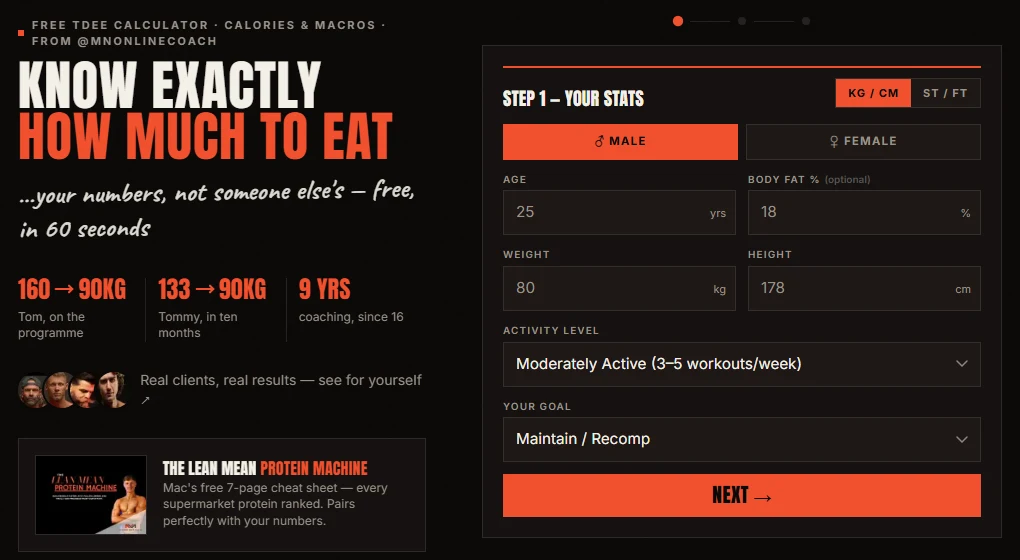
The 14 units comes from the NHS low-risk drinking guideline. If you don't know your calorie numbers, start with what TDEE is and how to use it.
When it could be a medical problem
Genuinely high cortisol is a real condition called Cushing's syndrome. It's rare, and according to the NHS the most common cause is taking high doses of steroid medicine for a long time. It doesn't look like a bit of extra belly fat. Signs the NHS lists include:
- More fat on your neck, upper back, chest and tummy, with thinner arms and legs
- A red, round face
- Bruising easily, and stretch marks on your tummy, hips, breasts or under your arms
- Weakness at the top of your arms and legs
- Low sex drive, mood changes, and irregular or stopped periods
If that sounds like you, especially if you take steroid medicine, speak to your GP. They can arrange the right tests. A saliva test bought online won't tell you whether stress caused your belly fat.
Do ashwagandha, supplements or cortisol cocktails work?
Not for belly fat. Here's what the evidence says:
- Ashwagandha lowered blood cortisol a little in a 2025 analysis of trials. But a 2026 review of 20 trials found no significant effect on body weight or body fat. The trial often quoted for weight loss had 52 people, ran for eight weeks, found about 1.2kg more weight lost than placebo, didn't measure waist or body fat, and used an extract supplied by its maker.
- It isn't risk-free either. The Dutch side-effects centre has reported rare cases of liver damage, and the UK's Food Standards Agency has been reviewing its safety.
- Cortisol or adrenal cocktails (orange juice, coconut water and salt) have no evidence behind them. An endocrinologist at the Cleveland Clinic says there's no evidence they lower cortisol, and the Endocrine Society says “adrenal fatigue”, the problem they claim to fix, isn't a recognised medical condition.
Fat loss has an order. People worry about sea moss, hormone resets and apple cider vinegar while having no idea how many calories they're eating. Calories come first.
What actually shifts belly fat?
You can't pick where you lose fat from. A review of 13 studies and 1,158 people found that training one area had no effect on the fat over it. So sit-ups won't do it. These will:
- A calorie deficit. Belly fat comes off with the rest of your body fat. Nothing else on this list works without it.
- Enough protein. It keeps you full and protects your muscle while you're eating less. My high protein, low calorie meals make it easy.
- Training and steps. Exercise is good news for deep belly fat specifically. A review of 117 studies found exercise reduced it by about 6% even when people didn't lose weight on the scale.
- Sleep. Seven hours or more. My rules are simple: a proper wind-down in the last half hour to an hour, the same bed and wake times every day, a cool, dark room, and no caffeine after 2pm.
- Less alcohol. Stick under 14 units a week and spread it out, as the NHS advises.
Is it my age, or the menopause?
Age is less of an excuse than people think. A study of over 6,000 people found that metabolism, adjusted for body size, holds steady from about 20 to 60. What usually creeps up over the years is the sitting and the grazing.
The menopause is different, and it's real. The large US SWAN study found that around the menopause, the rate of fat gain doubles and muscle starts to drop, even though overall weight gain doesn't speed up. Deep belly fat rose by about 6 to 8% a year from two years before women's final period. That's a shift in where fat sits, and it's exactly why strength training and protein matter more in your 40s and 50s, not less.
Measure your waist, not just the scale
The simplest belly fat check there is: your waist should be less than half your height. That's the guidance from NICE, and the NHS has a waist-to-height calculator. If you're 5ft 10in (178cm), that means a waist under 89cm, or about 35 inches.
Measure at the same time each week, and track it alongside your weight. In my experience, the lower belly is usually the last bit to go. It only shifts if you stay consistent long enough to outlast it.
Stress is real. So is the fix.
If you're stressed, you deserve better than being sold a powder. The things that shift belly fat are boring and they work: eat a bit less, get enough protein, train, walk, sleep, drink less. The hard part is doing it on a bad week, when work is mental and nobody's checking in.
That's what my coaching is for. Start with the 28-Day Blueprint to get the basics in place, or have a look at 1-1 coaching for the full rebuild. And if the scale has stalled, read why you might not be losing weight even though you exercise.
Frequently asked questions
What does cortisol belly look like?
How does cortisol cause belly fat?
What are cortisol triggering foods?
How is high cortisol diagnosed?
Does ashwagandha get rid of belly fat?
Do something with it
Reading is the easy rep. The next one is seeing how this works applied to you.
Get the basics that shift belly fat set in 28 daysKeep going
Read next
Mac on Instagram


Watch on YouTube
Tom Chapman: chasing abs at 42
Practising what I preach: my own 12-week prep phase