Fat loss & accountability
The New Year Weight Loss Plan That Survives February
By Maciej Nowicki · Updated 4 November 2026
A new year weight loss plan survives February when the target is 0.5 to 1 kg a week, meals are built around protein and fibre with nothing banned, training is three sessions you can actually keep, and someone holds you accountable past Quitter's Day on 8 January. Here is that plan, step by step.
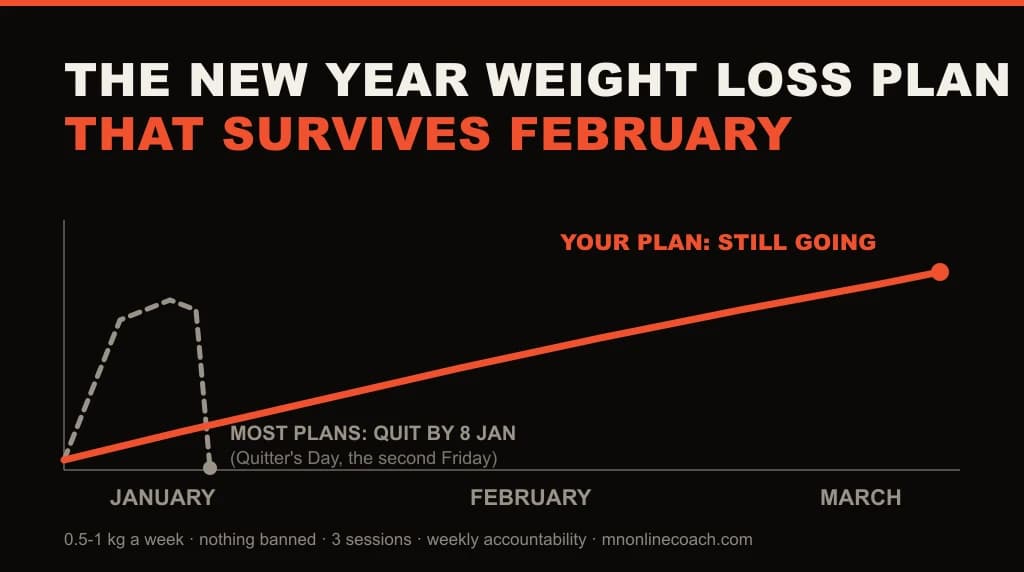
I'm Mac, and I've coached through nine Januaries. Every single one follows the same script: the gyms fill up in week one, thin out by week three, and by Valentine's Day most of the resolutions are quietly dead. Hardly anyone fails because they picked the wrong diet. They fail because they picked a plan that only works for a motivated person, and motivation is gone by February. So here's the opposite: a new year weight loss plan designed for the version of you that exists on a wet Tuesday in week six.
Why most new year weight loss plans die by February
Strava once analysed hundreds of millions of workouts and found that resolutions collapse so predictably they could name the date: the second Friday of January, now known as Quitter's Day. In 2027 that's the 8th of January. One week. The often-quoted figure is that around 80% of resolutions are abandoned by February, and the classic Journal of Clinical Psychology study of New Year resolvers measured it properly and still found barely one in two succeeding by summer.
Having watched this from the coaching side for nine years, the causes are boringly consistent:
- The deficit is too aggressive. Slashing to 1,200 calories works for a fortnight, then hunger, low energy and a blowout weekend end it.
- The rules are all-or-nothing. No takeaways, no alcohol, no chocolate. One “failure” and the whole plan feels broken, so it gets binned.
- The training plan assumes a perfect week. Six sessions looks great on paper. Your actual diary laughs at it.
- Nobody is watching. When the only person you answer to is you, week six is very easy to negotiate with.
Fix those four things and you don't need January motivation at all. That's the whole trick.
The plan, step by step
Step 1: start the week you decide, not on 1 January
The best time to start is now, even if “now” is mid-December. Starting before Christmas sounds mad, but a loose version of the plan running through the festive season beats a perfect version that starts hungover on New Year's Day. You walk into January already moving, while everyone else is white-knuckling day three.
Step 2: set a target you can actually hit
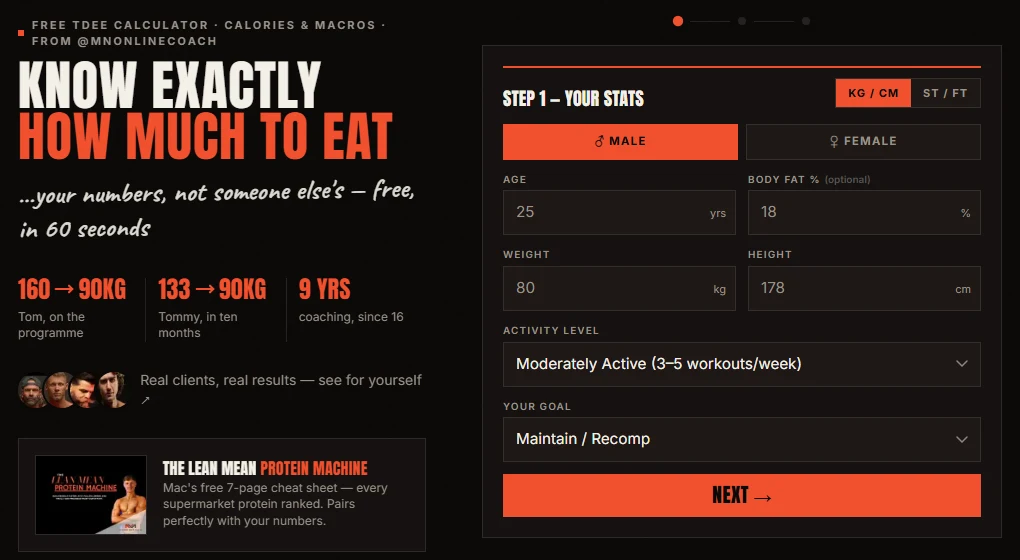
Aim to lose 0.5 to 1 kg (1 to 2 lb) a week, which is the pace NHS guidance also points to. In energy terms a pound of fat is roughly 3,500 calories, so a deficit of about 500 calories a day gets you a pound a week without wrecking your training or your mood. Work out your own numbers first: find your TDEE and then set a sensible deficit below it. Expect the scale to drop faster in week one. That early whoosh is mostly water and stored carbohydrate leaving, not fat, and it slows for everyone. Plan for it so it doesn't rattle you.
Step 3: build meals around protein and fibre, keep the takeaway
I coach an 80/20 approach: roughly 80% of your food does a job (protein at every meal, vegetables, whole grains, fruit), and 20% is just food you enjoy. The Friday takeaway stays. Banning foods is how January plans manufacture their own February collapse, because a plan you resent is a plan you quit. Protein and fibre do the heavy lifting here: both keep you full, and higher protein intakes protect your muscle while the fat comes off.
Step 4: train three times a week, not six
Two or three strength sessions plus more daily movement beats any heroic six-day split you'll abandon by week four. Strength training matters more than cardio for body shape, because it tells your body to hold onto muscle in a deficit. On top of that, add around 2,000 extra steps a day. A word on January gyms: they're rammed for the first three weeks, then empty out. If busy floors put you off, train at home for three weeks or go off-peak. By February you'll have the place back, because most of the crowd won't.
Step 5: spend ten minutes a week planning
Sunday evening, ten minutes: pick the week's meals, do one shop, look at your diary and decide which three days you train. Hungry and unprepared at 6pm on a Wednesday is where good intentions go to die. Ten minutes of planning is the cheapest weight loss tool that exists.
Step 6: put your February defences in before you need them
This is the step everyone skips, and it's the one that decides whether you're still going in March. Motivation gets you through January. Structure gets you through February:
- Tell someone your target and report to them weekly. Accountability is the single biggest difference I see between clients who finish and people who restart every January.
- Anchor habits to things you already do: gym bag packed the night before, protein sorted at breakfast before the day gets messy.
- Track non-scale wins too: how clothes fit, energy, strength going up. The scale stalls for everyone at some point; here's what's usually going on when it does.
- Put Quitter's Day (8 January) in your calendar with one line: “this is the day most people quit. Keep going.”
What about the Christmas weight?
Research on festive weight gain, including a much-cited New England Journal of Medicine study, puts the real average at roughly 0.4 to 0.9 kg over Christmas, which is a lot less than the half stone it feels like on 2 January. Much of what the scale shows that week is water and stored carbohydrate from a fortnight of bigger meals, salt and alcohol, and it drops off within two to four weeks of normal eating. So don't punish yourself with a detox or a crash diet in week one. Run the plan above and the Christmas weight sorts itself out while the actual fat loss gets going underneath.
What my clients who survive February do differently
Tom came to me at 160 kg and is now under 90 kg. His words, not mine: “there is no finish point. It's about constant progress and realising that fitness is forever.” That mindset is the opposite of a January sprint, and it's why his results stuck. Tommy dropped from 133 kg to under 90 kg in ten months, a stretch with a full Christmas in the middle of it. Jack built his around a young family and a business, which killed the excuse most people lean on by mid-January. Craig's edge was never intensity, it was showing up on the weeks he didn't feel like it. You can read their full stories here. None of them had a magic January. They had an ordinary January, a decent February and then another ten of the same.


If you want that kind of structure around your own new year, this is literally the job of an online fitness coach: the plan gets built around your life and someone checks in with you every single week, including the weeks you'd rather hide.
New year weight loss plan FAQs
How much weight can you realistically lose in January?
Is it realistic to lose 2 pounds a week?
How do I stick to a new year weight loss plan past February?
What is the NHS 12-week weight loss plan?
How much weight do people actually gain over Christmas?
Do I need a coach to lose weight in the new year?
Do something with it
Reading is the easy rep. The next one is seeing how this works applied to you.
Make January a 28-day challenge insteadKeep going
Read next
Mac on Instagram



Watch on YouTube
Tom Chapman: chasing abs at 42