Nutrition
How Much Protein Is in Chicken Breast? Raw vs Cooked (UK Guide)
By Maciej Nowicki · Updated 23 November 2026
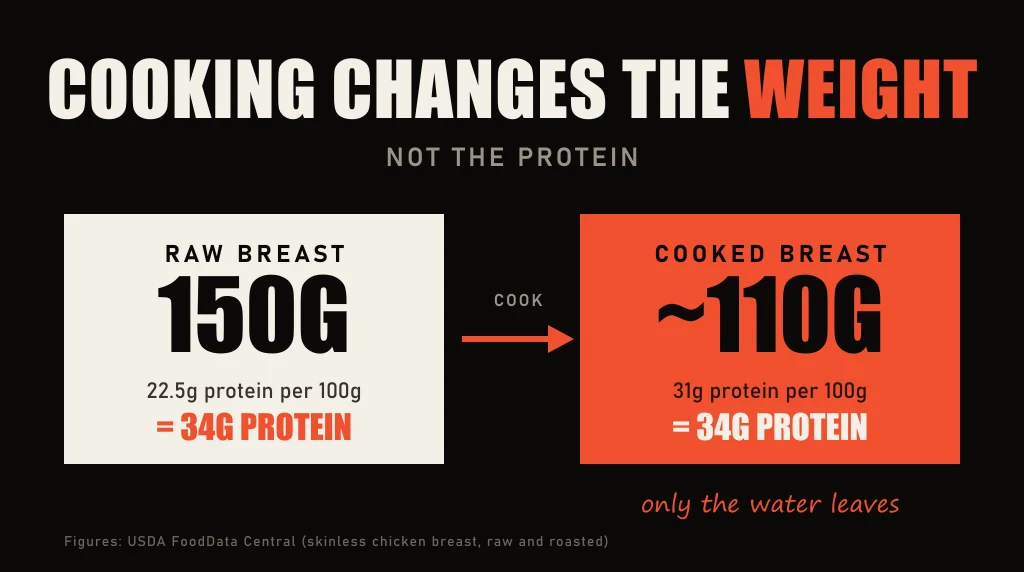
Cooked, skinless chicken breast has about 31g of protein per 100g. Raw chicken breast has about 22 to 23g. The protein doesn't change when you cook it. Water leaves, so the meat shrinks by roughly a quarter. A 150g raw breast gives you about 34g of protein, whichever way you weigh it, as long as you log the matching figure.
I'm Mac. At 16 I walked into a boxing gym, and within a few weeks I'd bought my first bag of protein. Nearly ten years later, chicken breast is still the first thing in my weekly shop, and “how much protein is in this?” is still one of the questions I get asked most. The answer sounds simple. Then people start weighing their chicken, and it gets messy, because the number on the packet and the number on your plate don't match. Here's why, and what to do about it.
How much protein is in chicken breast?
It depends on one thing: whether the chicken is raw or cooked. Here are the numbers from the USDA FoodData Central database and a standard UK supermarket pack:
| Chicken breast | Protein | Calories |
|---|---|---|
| Per 100g, cooked (roasted) | 31g | 165 kcal |
| Per 100g, raw | 22.5g | 120 kcal |
| Per 100g, Tesco pack label (as sold) | 21.5g | 115 kcal |
| One 150g raw breast | about 32 to 34g | about 175 kcal |
| One 200g raw breast | about 43 to 45g | about 235 kcal |
The cooked and raw figures are the USDA entries for roasted chicken breast and raw skinless chicken breast. The pack figure comes from Tesco British Chicken Breast Fillets. Different breeds and suppliers vary a little, which is why the per-breast numbers are a range.
Raw vs cooked: why the numbers don't match
Cooking doesn't add protein. It takes water out. Chicken breast loses roughly a quarter of its weight in the oven or the pan, so the same protein ends up packed into a smaller piece of meat. A 150g raw breast comes out at around 110g cooked, and it still has the same 34g or so of protein in it.
That's why 100g of cooked chicken has more protein than 100g of raw chicken. Nothing changed except the water.
The tracking mistake almost everyone makes
The problem starts when you mix the two. Say you weigh 150g of cooked chicken and log it using the raw figure from the pack. You record about 34g of protein and 180 calories. You actually ate about 46g of protein and 250 calories.
That's around 70 calories you can't see, every portion. Do it twice a day and you're missing roughly 1,000 calories a week from your log, then wondering why the scale has stopped. I see this on new clients' food diaries all the time, and it's one of the reasons people stop losing weight even though they're doing everything right.
What does a UK chicken pack label actually tell you?
UK supermarket packs give nutrition per 100g as sold, which means raw. The Tesco fillets above say 21.5g of protein and 115 calories per 100g. That number only works if you weigh the chicken raw.
Pick one way and stick to it:
- Weigh it raw, log the pack label. The most accurate option, and the easiest if you cook one portion at a time.
- Weigh it cooked, log a cooked entry. Search your tracking app for “chicken breast, cooked” or “roasted”, not the raw one.
- Batch cooking? Do the maths once. Weigh the whole raw pack and work out its total protein from the label. A 650g pack at 21.5g per 100g is about 140g of protein. Cook it, weigh all of it cooked, and divide. If it comes out at around 470g, every 100g of cooked chicken from that batch is about 30g of protein.
How much protein do you actually need a day?
This is where most articles stop being useful, because there are three different numbers floating around, and they answer different questions.
- 50g: the figure on UK food labels. It's the legal reference intake used to work out those “% of your RI” boxes. It's a labelling standard, not a target for someone training.
- 0.75g per kg of bodyweight: the UK Reference Nutrient Intake for adults, according to the British Nutrition Foundation. That's about 56g a day for men and 45g for women. It's the amount that covers basic needs for most people. It isn't an amount built for training or for losing fat while keeping muscle.
- 1.2 to 2.0g per kg: what the American College of Sports Medicine recommends for people doing strength training, as quoted by the same British Nutrition Foundation page.
I set most of my clients at around 2g per kg, the top of that range. A 2018 review of 49 studies in the British Journal of Sports Medicine found that, on average, extra muscle gain levelled off at about 1.6g per kg a day, so 2g gives you a buffer above that. It also helps when you're eating less: a 2015 review in the American Journal of Clinical Nutrition found higher-protein diets during a calorie deficit led to more fat loss and helped people keep their muscle. An 80kg person at 2g per kg needs about 160g of protein a day.
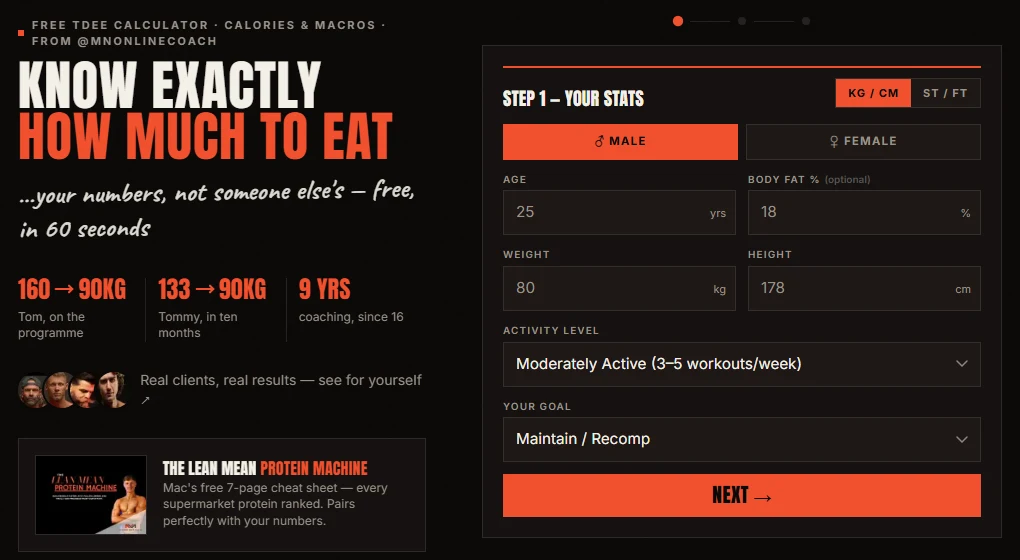
Protein is only part of the picture, though. It sits inside your calorie target, and that number comes first. If you don't know yours yet, start with what TDEE is and how to use it, or let the calculator do it for you.
How many chicken breasts is that?
Take that 80kg person needing 160g a day. From chicken alone, that's nearly five 150g raw breasts, every single day. Nobody sticks to that, and you shouldn't try.
Chicken works best as one of a few protein sources spread across the day. One breast at lunch or dinner covers a big chunk of your target. Eggs, Greek yoghurt, mince or fish cover the rest. Spread it across three or four meals and it stops feeling like a chore.
Which meat is highest in protein?
Chicken breast is near the top, but it isn't alone. Here's how common foods compare per 100g cooked, again from USDA FoodData Central:
| Food (cooked) | Protein | Calories | Protein per 100 kcal |
|---|---|---|---|
| Turkey breast | 30.1g | 147 kcal | 20.5g |
| Chicken breast | 31g | 165 kcal | 18.8g |
| Beef mince, 5% fat | 29.2g | 193 kcal | 15.1g |
| Chicken thigh | 24.8g | 179 kcal | 13.9g |
| Salmon (farmed) | 22.1g | 206 kcal | 10.7g |
| Egg, hard-boiled | 12.6g | 155 kcal | 8.1g |
| Lentils | 9g | 116 kcal | 7.8g |
Chicken breast gives the most protein per 100g, but turkey breast gives slightly more for the calories. Thighs and salmon have less protein and more fat, which isn't a bad thing. Fat keeps you full and makes food worth eating. It just means more calories for the same protein.
If you want the full list, my free Lean Mean Protein Machine guide ranks the supermarket proteins I recommend by what they give you per calorie.
How I prep chicken so I actually eat it
Most people don't need another recipe. They've saved fifty meal prep videos and made none of them. Carbs are easy: rice, wraps, pasta, potatoes, sorted in minutes. Veg is easy: frozen bags, salad bags, stir-fry packs. Protein is where people fall apart, because you actually have to cook it, plan it and have it ready when you're tired.
So I prep the protein first. A big batch of chicken, cooked in a way I actually like eating. Lately that's been a load of breasts marinated with a bit of coconut oil, cajun seasoning, paprika, salt and pepper. Some weeks I go plain. Then it's the same boring anchor in different meals all week: wraps, rice bowls, pasta, salads.

Make your food so easy to stick to that falling off becomes harder than staying on.
Two safety points, because this is chicken:
- Cook it all the way through. The Food Standards Agency says poultry can carry bacteria right through the meat. Check the juices run clear and there's no pink left in the middle.
- Don't wash raw chicken. The NHS says washing meat actually raises your risk of food poisoning, because it splashes bacteria around your kitchen.
Knowing the number is the easy part
You now know more about protein in chicken than most people in your gym. Here's the honest bit: knowing it was never the problem. It's hitting your protein on a random Tuesday when you can't be bothered, week after week. That's what my coaching is built around.
If you want your food set up properly with someone checking in on you, the 28-Day Blueprint is the fastest way in. If you want the full rebuild, have a look at 1-1 coaching.
Frequently asked questions
How much protein is in one chicken breast?
Is the protein on a chicken pack for raw or cooked weight?
How much protein is in 150g of cooked chicken breast?
Does cooking chicken reduce the protein?
Do I need protein shakes as well as chicken?
Do something with it
Reading is the easy rep. The next one is seeing how this works applied to you.
Get your food set properly in 28 daysKeep going
Read next
Mac on Instagram



Watch on YouTube
Practising what I preach: my own 12-week prep phase