Nutrition
Does Creatine Make You Gain Weight? What the Scale Really Shows
By Maciej Nowicki · Updated 16 November 2026
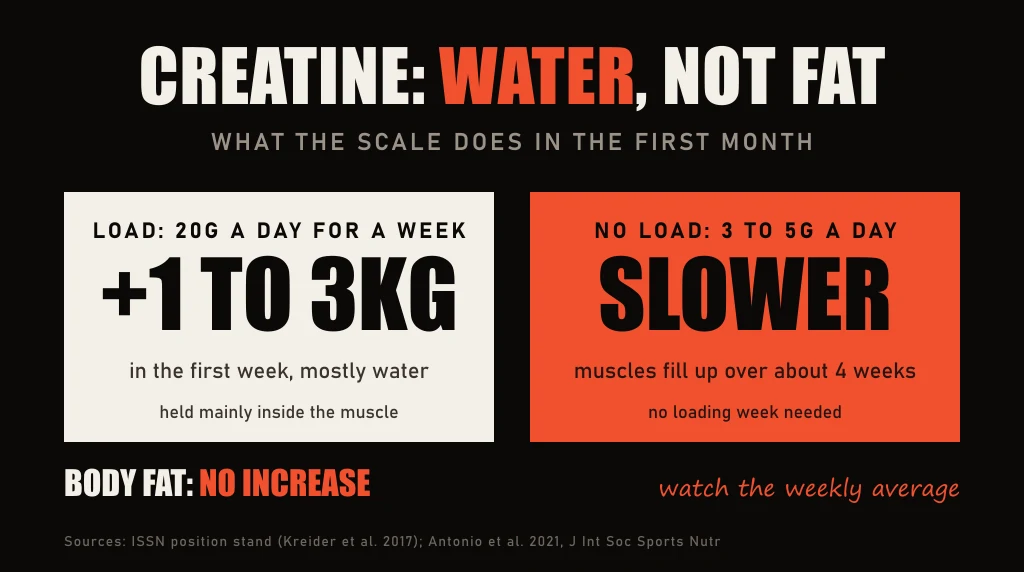
Yes, a little, and it's water, not fat. If you load creatine at 20g a day, your weight typically goes up 1 to 3kg in the first week, mostly from water held in your muscles. Take 3 to 5g a day without loading and the change is more gradual. Research shows creatine doesn't increase body fat.
I'm Mac. I take a few supplements for different reasons, and creatine is one of them. I'd still tell you supplements are the last thing to sort, after your calories, protein, training and sleep. But creatine is the one I get asked about most, and the question is nearly always the same: will it make me put weight on? Short answer: the scale will probably go up a bit, and no, it isn't fat. Here's what's actually happening, and how to stop it messing with your head when you're trying to lose weight.
Does creatine make you gain weight?
Usually, yes, a little. The International Society of Sports Nutrition's position stand on creatine, which pulls together decades of research, calls weight gain “the only consistently reported side effect”.
How much depends on how you take it. A 2021 review of common creatine myths found that a loading phase of 20g a day for 5 to 7 days typically adds 1 to 3kg, mostly water. Across a 2024 analysis of 143 trials, the average increase in body weight was smaller, at 0.86kg.
| Loading | No loading | |
|---|---|---|
| How you take it | 20g a day, split into four 5g doses, for 5 to 7 days, then 3 to 5g a day | 3 to 5g a day from day one |
| When your muscles are full | About a week | About 4 weeks |
| What the scale does | Often up 1 to 3kg in the first week, mostly water | A more gradual change |
| Stomach problems | More likely if you take big doses in one go | Less likely at normal doses |
The timings come from the same position stand, which found that 3g a day for 28 days fills your muscles more gradually than loading, but gets there in the end.
Is creatine weight gain water or fat?
Water, mostly. Creatine draws water into your muscles. The position stand found that loading caused short-term fluid retention of about half a litre to a litre, roughly in line with the weight people gained. The 2021 review says that extra water sits mainly inside the muscle cells, and that over longer periods creatine may not cause water retention at all.
It isn't fat. The 2021 review says creatine “does not increase fat mass”, across a wide range of people. It isn't a fat burner either. A 2023 review of adults under 50 who lifted weights found a very small drop in body fat percentage with creatine, but no real change in the actual kilos of fat. As one doctor told the American Medical Association, creatine alone won't make you lose fat.
Over months of training, some of the extra weight can be muscle. Creatine helps you squeeze out a bit more on hard, repeated efforts, and more work in the gym adds up.
Can creatine make you gain belly weight?
No. It doesn't add fat, and the water it pulls in goes mainly into your muscles, not round your middle. If your stomach feels off after starting creatine, the dose is the more likely cause. There's more on that in the side effects section below.
Should you take creatine if you're trying to lose weight?
You can. The creatine is fine. The risk is how you react to the scale. Someone starts it on Monday, sees 1.5kg more on Friday, panics and either slashes their calories or quits everything. Neither helps.
The scale moves with water all the time. Earlier this year I had a stomach bug, dropped to a really low weight and felt flat. One week of eating at maintenance and a bit above and I was back at 80kg. Most of that was water and stored carbs refilling, not fat. Creatine is just one more thing that moves the number. Here's how I get clients to handle it:
- Don't start it the same week as a diet. Give it a couple of weeks either side, so you know which change caused what.
- Skip the loading phase. 3 to 5g a day gets you to the same place, just more gradually.
- Use your weekly average. Weigh yourself most mornings and compare one week's average with the next, not one day with the day before.
- Track more than the scale. Waist measurement, progress photos and your lifts tell you far more about fat loss than one number.
- Expect one step up, then carry on. Once your muscles are full, the trend should go back to doing what your calories say it should.
If the weekly average still hasn't moved a month later, look at your calories. Start with why you might not be losing weight even though you exercise and how far below your TDEE you should eat.
Does creatine make women gain weight?
Less than most people fear. A 2021 review of creatine in women found it works for women without marked changes in body weight, and that the quick water weight gain is more common in men. The researchers called the fear of weight gain “largely unfounded”, particularly in women. The doses that worked were the same as for men: a short loading phase, or 5g a day for four weeks.
What are the side effects of creatine?
- Weight gain. Covered above. It's water, and it's the side effect you're most likely to notice.
- Stomach problems from big doses. In a study of 59 footballers, 56% of those taking a single 10g dose got diarrhoea, against 29% of those taking two 5g doses (and 35% on a placebo). If you load, split it up. Better still, don't load.
- Bloating. People blame creatine for it a lot, but the studies mostly report stomach upset and diarrhoea rather than bloating, and mainly at big doses.
- Kidneys. In healthy people, the position stand found no good evidence of harm, even at up to 30g a day for five years. If you already have kidney problems, speak to your doctor first. Creatine can also push up creatinine on a blood test without meaning anything is wrong with your kidneys, according to a 2023 review, so tell your GP you take it before any blood test.
If you have a medical condition or take regular medication, check with your GP or pharmacist before starting any supplement.
How much creatine should you take?
- Type: creatine monohydrate. It's the form with the research behind it and the one the AMA article tells people to look for.
- Dose: 3 to 5g a day, every day. The UK's approved health claim for creatine is based on 3g a day, for adults doing high intensity exercise.
- Loading: optional. The 2021 review is clear that you don't have to load.
Where creatine actually fits
Nobody makes money telling you to sleep more, walk more and write your lifts down. So you get sold supplements instead. Creatine is one of the few with real evidence behind it, and it's still a 1%er. Fat loss has an order: calories first, then protein, training and sleep. Get those right and creatine might help you squeeze a bit more out of your sessions. Get them wrong and no tub of powder will save you.
If you want the basics set up properly, with someone checking your weekly average so a jump on the scale doesn't derail you, start with the 28-Day Blueprint. For the full rebuild, have a look at 1-1 coaching.
Frequently asked questions
Is weight gain from creatine permanent?
What happens after 1 month of creatine?
Do I need to load creatine?
Does creatine make you look bloated?
Can women take creatine?
Do something with it
Reading is the easy rep. The next one is seeing how this works applied to you.
Get the basics right before the supplementsKeep going
Read next