Fat loss & accountability
How Many Steps a Day to Lose Weight? A UK Coach's Honest Answer
By Maciej Nowicki · Updated 23 November 2026
There's no magic number, but 8,000 to 10,000 steps a day is a sensible target for most people trying to lose weight. In weight-loss programmes, people averaged about 8,500 steps a day while losing. Steps work alongside a calorie deficit, adding roughly 20 to 35 extra calories for every 1,000 steps.
I'm Mac. When someone asks me how many steps they need to lose weight, they usually want one number they can hit and forget about. I get it. But steps are one of the most misunderstood tools in fat loss. People either ignore them completely or treat them like a fat burner, and both are mistakes. Here's what the research says, what your steps actually burn, and the target I'd give you depending on where you're starting from.
How many steps a day do you need to lose weight?
There isn't one number that works for everyone, but the research points to roughly 8,000 to 10,000 steps a day.
A 2026 review of 18 weight-loss trials tracked people's steps through diet and lifestyle programmes. They started at about 7,300 steps a day and averaged about 8,450 while they were losing weight, for an average loss of about 4.4%. The authors suggested aiming for around 8,500 a day. They also called the findings preliminary, so treat that as a sensible target, not a magic line.
A US trial of 260 adults on a calorie-controlled diet found something similar after 18 months. The people who lost 10% or more of their body weight were averaging about 9,800 steps a day, and around 3,500 of those came from brisk walks of 10 minutes or longer. The people who lost less averaged about 7,800 to 8,600. That's an observational finding, so it shows a link rather than proof, but it lines up with what I see in clients.
Where does 10,000 steps come from?
Not from research. According to a 2019 paper in JAMA Internal Medicine, it most likely comes from the name of a pedometer sold in Japan in 1965, which translates as “10,000 steps meter”. It was a good marketing slogan that stuck.
That doesn't make 10,000 a bad target. It's just not a rule. A study of over 47,000 adults found the health benefits of steps level off at around 8,000 to 10,000 a day if you're under 60, and 6,000 to 8,000 if you're over 60. That study looked at lifespan, not weight, but it's a useful sense check.
How many calories do 1,000 steps burn?
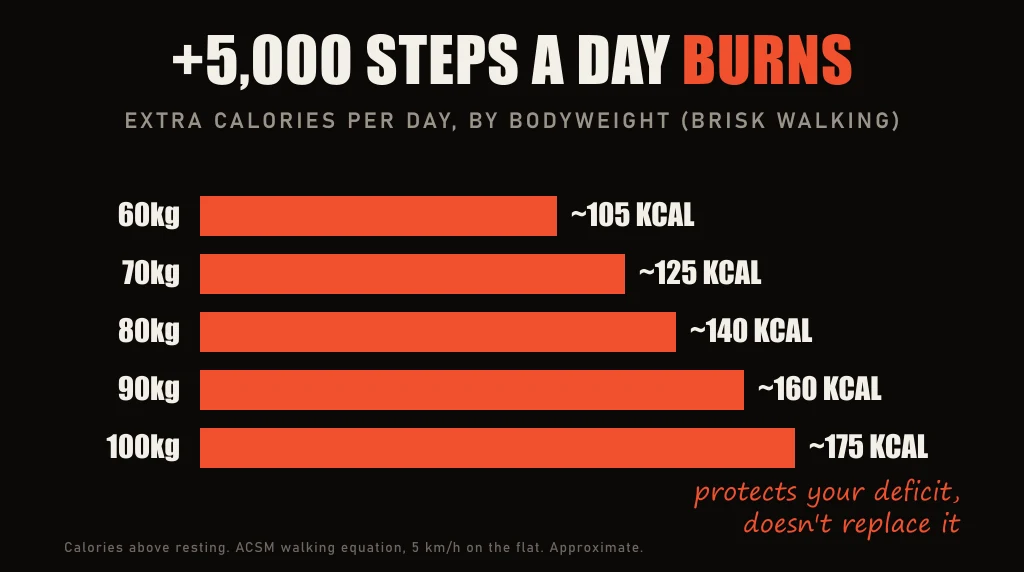
Less than most people think. Using the standard walking equation from the American College of Sports Medicine, brisk walking on the flat burns roughly 20 to 35 extra calories per 1,000 steps for most adults. “Extra” matters here. You'd burn some calories sitting on the sofa anyway, so the useful number is what walking adds on top.
| Bodyweight | Per 1,000 steps | Per 5,000 extra steps a day | Per week |
|---|---|---|---|
| 60kg (9st 6lb) | about 21 kcal | about 105 kcal | about 735 kcal |
| 70kg (11st) | about 25 kcal | about 125 kcal | about 875 kcal |
| 80kg (12st 8lb) | about 28 kcal | about 140 kcal | about 980 kcal |
| 90kg (14st 2lb) | about 32 kcal | about 160 kcal | about 1,120 kcal |
| 100kg (15st 10lb) | about 35 kcal | about 175 kcal | about 1,225 kcal |
These are worked out for a brisk 5km/h walk on the flat, and they're estimates. Hills, a faster pace or a heavy rucksack push them up. If you want a quick rule of thumb, walking costs roughly half a calorie per kilo of bodyweight for every kilometre, on top of what you'd burn at rest.
You'll see figures of 30 to 50 calories per 1,000 steps on other sites. That's usually the total, including the calories you'd have burned anyway, which makes walking look like it does more than it does.
Don't trust your watch's calorie number
In a Stanford lab study of seven wrist trackers, none of them estimated calories burned to within 20%, and some were out by over 90%. Use your watch to count steps, not calories.
People are just as bad at it. In a small study, volunteers guessed they'd burned three to four times what they really had, then ate two to three times more than they'd burned. That's why I never let clients eat their steps back. Count the steps, ignore the calories on your watch.
What do steps actually do for your deficit?
Here's a typical example. Say you're 85kg (about 13st 5lb), you're doing 4,000 steps a day, and you build up to 9,000. That's 5,000 extra steps, which burns roughly 150 extra calories a day, or about 1,050 a week.
If you're eating 500 calories a day under your maintenance, those steps add about another 30% on top. That's real, but it's not going to undo a weekend of takeaways. Your body also claws some of it back. A study of over 1,700 adults found that, on average, the body offsets about 28% of the calories burned through extra activity, so you get roughly three quarters of what the maths says.
So think of steps as protection for your deficit. The deficit itself comes from your food. If you don't know your numbers yet, read what TDEE is and how to use it and how far below it you should eat, or let the calculator work it out.
Why steps matter more than the calories suggest
If walking only burns a few hundred calories, why do I care so much about it? Because the movement you do outside the gym adds up to more than most people's training.
Scientists call it NEAT: non-exercise activity thermogenesis. It's walking, standing, taking the stairs, fidgeting, everything that isn't a workout. In a well-known study published in Science, volunteers were overfed by 1,000 calories a day for eight weeks. Two thirds of the extra energy they burned came from this kind of everyday movement, and the people who moved more naturally gained the least fat.
Here's what I see with clients. When people diet, their daily movement quietly drops. They sit more, take the lift, drive the short trip. None of it feels like a decision, but it eats into the deficit they're working so hard for. A step target stops that happening. That's why I treat steps as a floor you don't drop below.
What step target should you aim for?
Start from where you are, not from 10,000. Check your phone or watch for your average over the last week, then use this:
| Your average now | What I'd aim for |
|---|---|
| Under 5,000 | Add 2,000 a day for the first fortnight, then build to 7,000 to 8,000 |
| 5,000 to 7,500 | 8,000 to 9,000 |
| 7,500 to 10,000 | Hold it there and make 30 minutes of it brisk |
| Over 10,000 | Steps aren't your problem. Look at your food |
Under 5,000 is what researchers class as a sedentary day, so that's where the biggest wins are. Jumping straight from 3,000 to 10,000 usually lasts about a week. Building up sticks.
Does the pace matter?
A bit. Walking at about 100 steps a minute or faster counts as moderate intensity, the same level the UK Chief Medical Officers want you doing for 150 minutes a week. You don't need every step to be brisk. A couple of proper 10 to 15 minute walks a day, with the rest of your steps happening naturally, does the job.
Do steps help you keep the weight off?
This is where they really earn their place. In the same 2026 review, people in the maintenance phase were still doing about 8,250 steps a day, well above the comparison groups, and still holding on to most of their weight loss. The UK Chief Medical Officers' guidelines say the same thing: the evidence supports physical activity for keeping weight off after you've lost it.
A lot of people lose weight, then stop everything that got them there. Steps are the easiest habit to keep when the diet ends.
Can you lose belly fat by walking?
Walking won't burn fat from your stomach specifically. Nothing does. What it does is add to your overall deficit, and belly fat comes off with the rest. A 12-week trial found people who added 2.5 hours of walking a week to a calorie deficit lost more fat (6.4kg) than people who only dieted (4.8kg). Be wary of anyone giving you a special step number for belly fat. I couldn't find any research behind one.
How to get more steps in a UK winter
It's dark by half four and it's raining sideways. This is where most step targets die. What actually works for my clients:
- Walk after meals. Ten minutes after lunch and dinner is around 2,000 steps, and it becomes automatic quickly.
- Take calls on your feet. Phone calls and voice notes are free steps.
- Use the treadmill or a walking pad. A brisk 20 minutes on an incline while you watch something is still steps.
- Make the weekend count. A proper walk on a Saturday or Sunday tops up a quieter week. Living in Sheffield, I've got the Peak District on the doorstep, and the hills burn more than the flat.

How I use steps with clients
Every client gets a step floor, based on where they started. We track the weekly average, not single days, because one day at a desk doesn't matter. Rest days count too. One of my clients, Craig, lost 8kg in 12 weeks and thought it was down to training five times a week. A big part of it was what he did on his two rest days: 8,000 to 10,000 steps minimum, instead of a day on the sofa.
And when the scale stalls, we don't panic and slash calories. We look at the numbers first, and steps are one of the first things I check. More often than not, they've quietly dropped. If the scale has stalled for you, read why you might not be losing weight even though you exercise.
If you want your steps, food and training set up properly, with someone checking your weekly numbers, start with the 28-Day Blueprint. For the full rebuild, have a look at 1-1 coaching.
Frequently asked questions
Is 10,000 steps a day enough to lose weight?
How many steps does it take to lose a stone?
Can you lose belly fat by walking 10,000 steps a day?
Is 20,000 steps a day too much?
Do slow steps count?
Do something with it
Reading is the easy rep. The next one is seeing how this works applied to you.
Get your steps and food set in 28 daysKeep going
Read next
Mac on Instagram



Watch on YouTube
Practising what I preach: my own 12-week prep phase
Snowdon 2026